

Organic traffic is growing. More keywords are ranking. Several articles are bringing visitors to the website.
But qualified opportunities remain unchanged.
This is a common problem in B2B SEO, especially for technology, SaaS and cybersecurity companies. The activity appears successful when viewed through an SEO dashboard, yet its commercial impact is difficult to find.
The problem often starts with how the strategy was built. Keywords were selected according to search volume. Articles were created to attract traffic. Rankings became the principal measure of progress. Far less attention was given to what happens after someone discovers the content, or whether the people finding it resemble the company’s actual buyers.
For SEO to contribute to pipeline, it must support the research process behind a B2B purchase. That means attracting the right people, answering the questions that influence their decisions and giving them a credible path from initial research to vendor evaluation.
Traffic Growth Can Hide a Relevance Problem
More organic traffic generally appears positive. However, traffic only creates business value when it comes from relevant audiences and supports a meaningful next step.
A technology company can attract thousands of visits through broad informational topics without reaching the people involved in purchasing its solution. Some visitors may be students, job seekers, general researchers, or professionals looking for an answer with no commercial intent.
The content may be relevant to the company’s industry without being relevant to its sales process.
Consider a cybersecurity company publishing an article about the most common types of cyberattacks. The subject belongs to its market and may generate considerable search demand. But the audience is extremely broad, and the article may have little connection to the specific risk, use case or security control the company addresses.
Traffic increases, but the company gains limited influence over an actual buying decision.
A stronger content opportunity may have much lower search volume. A detailed article addressing how a regulated organization should evaluate a specific security capability could attract fewer readers while reaching buyers much closer to a commercial conversation.
This is why search volume cannot be the only measure of opportunity.
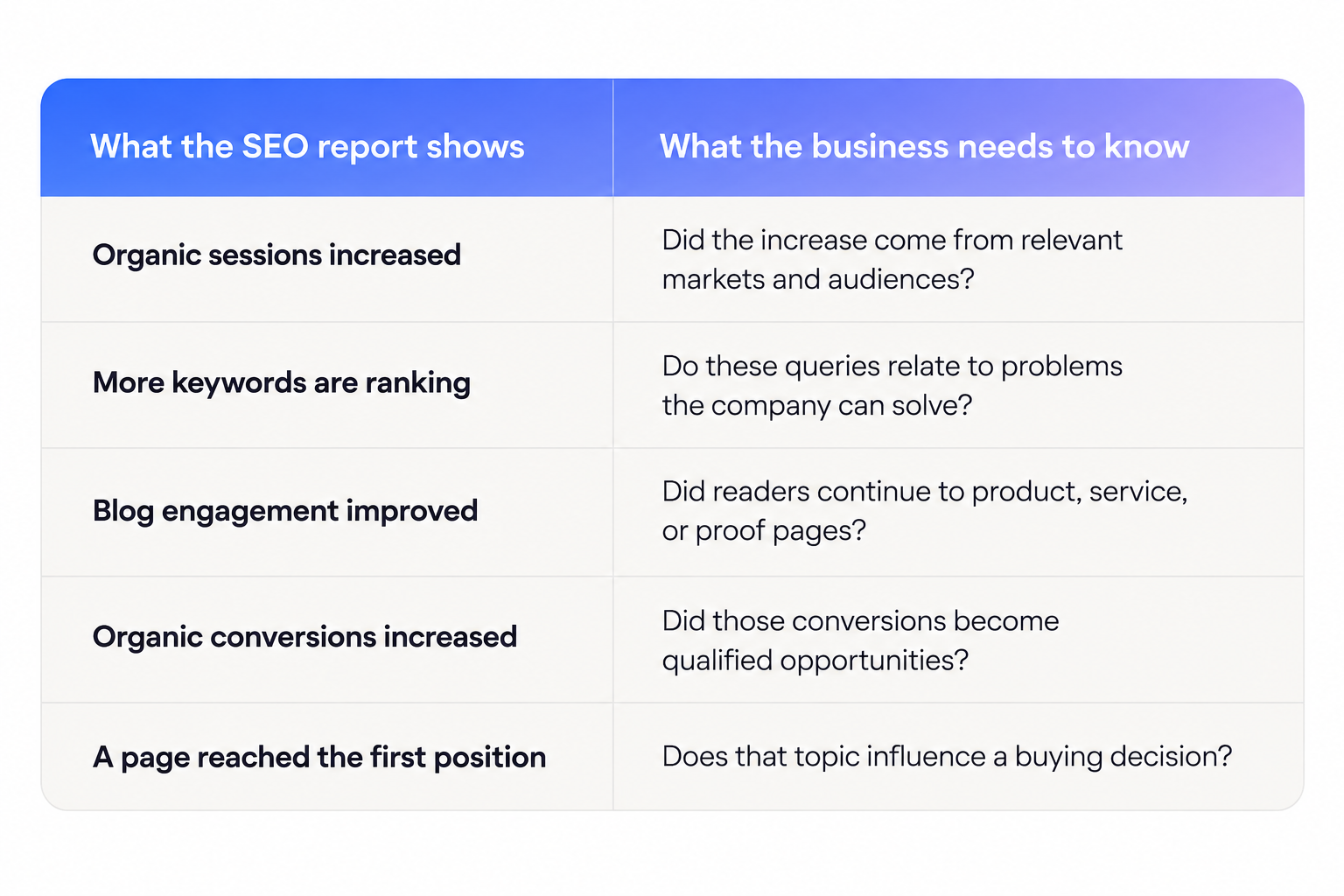
The purpose of these questions is not to dismiss traffic or rankings. Both remain valuable indicators. But they need to be interpreted in the context of audience relevance, buyer intent and commercial outcomes.
The Content Attracts Researchers but Gives Buyers Nowhere to Go
Many B2B websites contain useful articles that lead to a dead end.
The reader receives an answer but finds no clear connection between the subject and the company’s solution. The article may not link to a relevant product or service page. It may not provide a case study, implementation example or logical next question. The only conversion option may be a generic “Contact us” button placed far outside the reader’s immediate intent.
This creates a gap between content performance and commercial performance.
Someone researching an early-stage problem may not be ready to request a sales call. They may, however, be ready to explore:
- The available approaches to solving the problem
- The difference between two solutions
- The requirements for a specific industry or market
- A practical implementation guide
- A related case study
- A self-assessment or planning resource
The next step should match the reader’s current stage of research.
An educational article can lead to a more detailed guide. A comparison can link to a relevant product capability. A regulatory article can direct the reader to an industry use case. A technical explanation can lead to an implementation example.
Without these connections, the content may rank as an isolated resource but contribute little to the wider buying journey.
The Strategy Targets Topics Instead of Buying Decisions
A keyword can be relevant to the industry without being important to the buyer.
This distinction matters in complex B2B markets, where research rarely happens through a single search. Different stakeholders ask different questions at different stages.
A technical user may investigate functionality and integration. A security or compliance leader may focus on risk and regulatory requirements. Procurement may compare vendors, implementation demands and pricing structures. Senior management may look for evidence that the investment addresses a credible business risk.
A keyword list alone cannot capture this journey.
Before prioritizing a topic, companies should understand:
- Who is likely to search for it
- What triggered the search
- Which problem the person is trying to clarify
- How close the query is to a commercial decision
- What information the buyer will need next
- Whether the company has genuine expertise to contribute
- How the topic connects to a solution, service or category the company wants to own
This changes how content opportunities are evaluated.
Instead of asking only, “Can we rank for this keyword?” the company can ask, “What role would this content play in a buyer’s decision?”
The answer may be education, category framing, solution exploration, vendor comparison or final validation. Each role requires a different type of content and a different next step.
Commercial Pages Are Often the Weakest Part of the System
Blog content frequently receives most of the attention in an SEO program because it creates a regular publishing schedule and visible traffic growth. Yet the pages closest to the commercial decision are often left unchanged.
Product and service pages may contain:
- Broad positioning with little technical substance
- Lists of features without clear use cases
- Claims unsupported by evidence
- Limited industry or regional relevance
- No explanation of implementation
- Few answers to evaluation-stage questions
- Weak internal links from relevant resources
- Generic calls to action
This produces an uneven journey. The article demonstrates expertise, but the commercial page does not help the buyer evaluate the company.
For a complex B2B solution, a strong commercial page should help a prospect understand:
- Which problem the solution addresses
- Who it is designed for
- How it works
- Where it fits within the existing environment
- Which use cases it supports
- What differentiates the approach
- What evidence supports the claims
- What the appropriate next step would be
The page does not need to answer every technical question. It should answer enough of the right questions to maintain confidence and support further evaluation.
SEO content brings buyers into the research environment. Commercial pages determine whether they can continue moving through it.
Buyers Validate the Company Beyond Its Website
A buyer who discovers a company through search rarely evaluates it based on one article.
They may search the company name, review its LinkedIn presence, inspect leadership profiles, look for customer evidence, check partner pages, visit software directories or ask an AI platform to compare the company with other providers.
Each of these interactions can strengthen or weaken the credibility created by the original article.
This is particularly important in technology and cybersecurity markets, where buyers need confidence in the company as well as the solution. An informative article may create initial interest, but inconsistent positioning, outdated profiles or limited third-party evidence can interrupt the evaluation.
Several common gaps appear at this stage:
- The company is described differently across its website and external profiles
- Search results show outdated messaging
- Review profiles are incomplete
- Published claims cannot be corroborated elsewhere
- Leadership expertise is difficult to verify
- Case studies offer little concrete evidence
- Recent company activity is absent
- AI-generated answers contain incomplete or inaccurate information
These issues may not appear in a conventional SEO report, but they affect whether organic discovery develops into commercial confidence.
Branded search, third-party presence, earned coverage and AI visibility therefore belong within the same research journey. Managing them separately can create inconsistencies at the exact point when a prospect is deciding whether the company deserves further consideration.
SEO and Sales Often Measure Different Journeys
Another reason SEO’s contribution remains unclear is that marketing and sales frequently observe different parts of the same buying process.
Marketing tools may identify the first organic session or the final form submission. Sales sees the meeting, opportunity and eventual revenue. Between those points, the buyer may read several articles, return through a branded search, review the company on LinkedIn, share a page internally and revisit the website directly.
A last-touch report may attribute the opportunity to direct traffic or a branded search, even though an educational article introduced the company weeks earlier.
At the same time, attributing every later opportunity to the first organic visit would overstate SEO’s role. The objective is to understand contribution rather than force every sale into a single channel.
Useful indicators include:
- Content-assisted opportunities
Identify which resources appeared in the research history of qualified and closed opportunities. This helps distinguish content that attracts visitors from content that supports real evaluations.
- Organic-influenced pipeline
Track opportunities where organic discovery played a documented role, even when it was not the final interaction before conversion.
- Branded search growth
An increase in searches for the company or product name can indicate that content, PR, events, social activity and sales outreach are creating greater market awareness.
- Movement from educational to commercial pages
Review whether readers continue from articles to product pages, case studies, industry pages or other evaluation content.
- Lead quality by landing page and topic
Compare the quality of opportunities generated or influenced by different topics.
- Sales feedback
Ask sales teams which resources prospects mention, share or request during conversations. Their feedback can reveal content influence that analytics cannot fully capture.
These measures create a more realistic view of how SEO supports a long and multi-touch buying journey.
What a Pipeline-Oriented B2B SEO Strategy Does Differently
A commercially focused SEO strategy still uses keyword research, technical optimization, content production and authority building. The difference lies in how those activities are prioritized and connected.
- It begins with the buying process
The strategy maps what different stakeholders research before, during and after vendor evaluation. Content is then planned around those questions.
- It balances demand with commercial relevance
Search volume remains useful, but it is assessed alongside buyer fit, intent, market relevance and connection to the company’s offering.
- It gives every page a defined role
Some pages create initial awareness. Others explain the category, support comparison, demonstrate capability or reinforce a shortlist decision. Each page has a clear purpose and next step.
- It connects educational and commercial content
Articles link naturally to relevant product pages, services, use cases, case studies and practical resources. Commercial pages also help visitors continue exploring important questions.
- It strengthens validation outside the website
Directory profiles, reviews, expert commentary, partner mentions, digital PR and consistent company information reinforce what the company says about itself.
- It accounts for AI-assisted research
Content is structured clearly enough to be understood and cited, while the company’s positioning is corroborated across credible sources.
- It measures influence on qualified opportunities
Rankings and sessions remain part of the reporting model, but they are reviewed alongside lead quality, content-assisted opportunities, branded demand and organic-influenced pipeline.
Turning Visibility Into a Connected System
Improving one article or commercial page can produce a useful result. Sustainable performance, however, depends on how the different parts work together.
The company needs to appear when buyers recognize the problem, when they explore possible solutions, when they compare providers and when they validate a shortlist. Its content, commercial pages, external presence and proof should reinforce one another throughout that process.
This requires a wider view of SEO, one built around buyer visibility rather than a publishing calendar or a collection of ranking targets.