

These dimensions reinforce one another. Strong content gives external sources something useful to reference. External validation supports recognition. Recognition can lead to more branded searches, direct visits and demand.
Owned Content Establishes the Company’s Position
A company’s website is usually the clearest source of information it controls. It should explain:
- What the company does
- Who it serves
- Which problems it addresses
- How its products or services work
- Where its expertise comes from
- How its approach differs
- What evidence supports its claims
This information needs to extend beyond the homepage.
Product pages, service pages, use cases, case studies and educational resources each serve a different purpose. Together, they give buyers and search systems a more complete picture of the company.
Depth matters more than volume. Publishing dozens of loosely related articles can make the website larger without strengthening the company’s association with the subjects that matter.
A focused content library should cover the important questions around a category, including the problem, available approaches, technical considerations, use cases, industry requirements, implementation questions and evaluation criteria.
The goal is to become a useful source across the topic, not to produce an article for every possible keyword variation.
External Sources Confirm the Position
A company can describe itself as experienced, innovative or a market leader. Those claims carry more weight when credible external sources support them.
Validation can come from:
- Customer reviews and case studies
- Industry publications
- Partner websites
- Professional associations
- Relevant directories and comparison pages
- Expert interviews and conference contributions
- Independent citations of the company’s research
The relevance of the source matters more than the number of placements. One mention in a respected industry publication can contribute more credibility than dozens of references on unrelated websites.
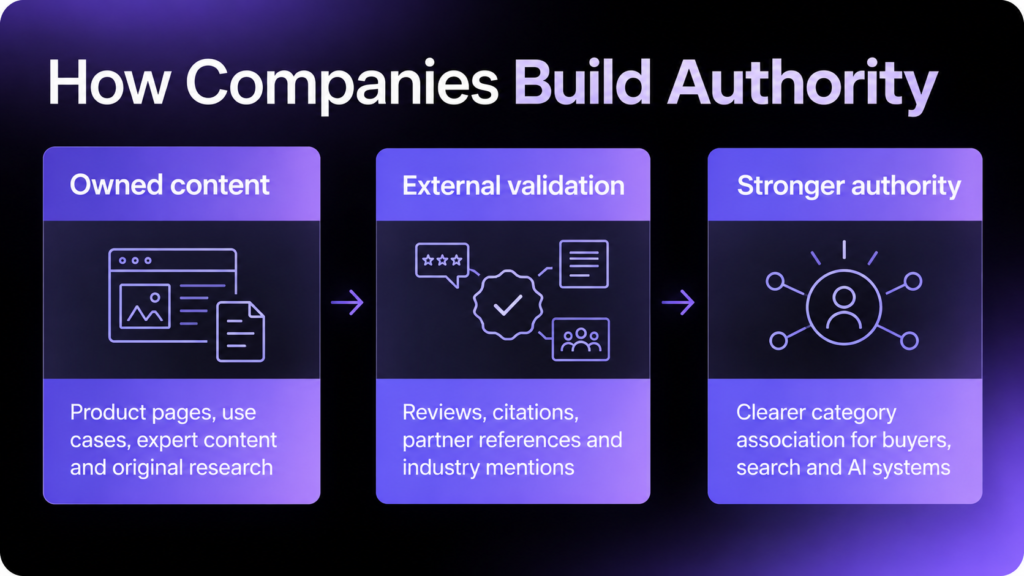
This matters for search visibility because relevant external references can strengthen the credibility of a website and its content. It also matters for AI visibility because generated answers may draw on third-party sources when identifying and comparing companies.
The wider internet provides context that a company’s website cannot create alone.
Brand Mentions Matter Alongside Backlinks
Backlinks remain useful because they connect pages and can signal that another website considers a source worth referencing. However, a company can also build recognition when credible sources discuss the brand without linking to it.
An Ahrefs study of 75,000 brands found that branded mentions across the web correlated strongly with visibility in ChatGPT, Google AI Mode and AI Overviews. YouTube mentions showed the strongest correlation of all the factors studied, while the number of pages on a website had almost no relationship with AI visibility.
The research shows correlation rather than proof that mentions directly caused visibility. Still, the pattern supports a practical point: being discussed in relevant contexts may matter more than publishing content at scale.
For companies, this broadens authority building beyond conventional link acquisition. The objective is to earn credible association with the subjects the company wants to own.
That may happen when:
- An industry article quotes the company’s research
- A customer discusses the product in a review
- A partner lists the company within a relevant solution category
- An expert mentions the brand during a podcast or video
- A publication includes the company in a credible market comparison
- A professional community discusses its approach
Collectively, these mentions create more evidence associating the company with the category and increase the likelihood that buyers encounter the brand during their research.
Consistency Strengthens Brand Association
Authority becomes weaker when a company describes itself differently across its website, LinkedIn page, directories and partner profiles.
One source may present it as a cybersecurity vendor. Another may describe it as a general IT company. The website may focus on one product category while external profiles use outdated language.
This makes the company harder to understand.
Consistency does not require repeating the same sentence everywhere. It means maintaining the same core facts:
- Company name and category
- Main offering and capabilities
- Target audience and markets
- Product names
- Relevant expertise
Clear and consistent information helps buyers recognize the company across different research environments. It also reduces the likelihood of AI-generated answers drawing from outdated or conflicting descriptions.
Repeated Visibility Builds Brand Equity
Brand equity develops when buyers become familiar with a company and associate it with relevant expertise, credible evidence, and a distinct position in the market.
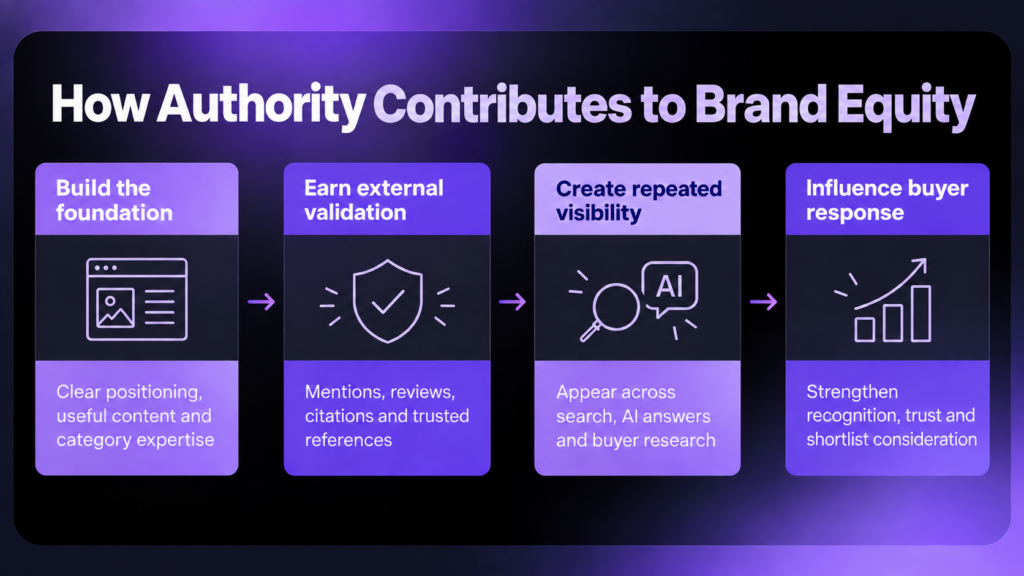
Search and AI visibility can contribute to that process through repeated exposure. Visibility alone does not create brand equity, but consistent appearances in credible and relevant contexts can strengthen recognition, trust and consideration over time.
A buyer may first encounter the company in an educational article. Later, it may appear in an AI-generated comparison, an industry publication and a review platform. When the buyer eventually reaches the company website or speaks with sales, the name is already familiar.
Each interaction may appear small in isolation. Together, they can shape recognition and confidence.
This is why visibility should not be evaluated only through immediate clicks or leads. Some of its value may appear through:
- Growth in branded search
- More direct website visits
- Increased mentions during sales conversations
- Better conversion from familiar prospects
- Inclusion in vendor shortlists
- More frequent recommendations and referrals
- Stronger presence across search and AI-generated answers
The company becomes easier to find because more relevant evidence exists around it. It can also become easier to choose because buyers encounter that evidence throughout their research.
Authority Cannot Be Built Through Volume Alone
More articles, backlinks and directory profiles do not automatically create authority. The quality, relevance and consistency of each signal matter.
Authority-building activity underperforms when companies publish generic content with no original contribution, acquire links from unrelated websites, join directories their buyers do not use or cover too many subjects without developing depth in any of them.
A more effective approach begins with a small number of categories the company can credibly own. For each category, the company should ask:
- Which buyer questions should our website answer?
- What original expertise or evidence can we contribute?
- Which external sources already influence this market?
- Where should our experts participate?
- Which claims need independent validation?
- Is our company presented consistently across these sources?
This creates a focused authority plan connected to how buyers research rather than a collection of disconnected SEO activities.
What Companies Should Build First
Authority takes time, but the starting point can be practical.