

Has SEO changed? Is it dead? Do we all have to move to AI now because no one searches on Google anymore?
These are the questions many business owners ask after reading content about the future of search. And you cannot blame them. These claims are everywhere.
So, let’s break down what is actually happening.
AI Overviews now answer questions directly in Google. ChatGPT, Gemini, Claude and Perplexity have become part of how people research. More searches end without a website visit, and traditional rankings represent a smaller part of the overall discovery environment.
These changes are significant. But they do not mean that people have stopped searching or that the foundations of SEO have become irrelevant.
The more useful question is: which parts of search genuinely changed, and which SEO fundamentals still determine whether a company gets discovered?
Let’s look at the facts. Search has expanded across more formats and platforms. Visibility does not always produce a click, and rankings alone provide an incomplete view of performance. Technical accessibility, relevance, original content and authority, however, remain central to both traditional and AI-assisted search.
What SEO Means in 2026
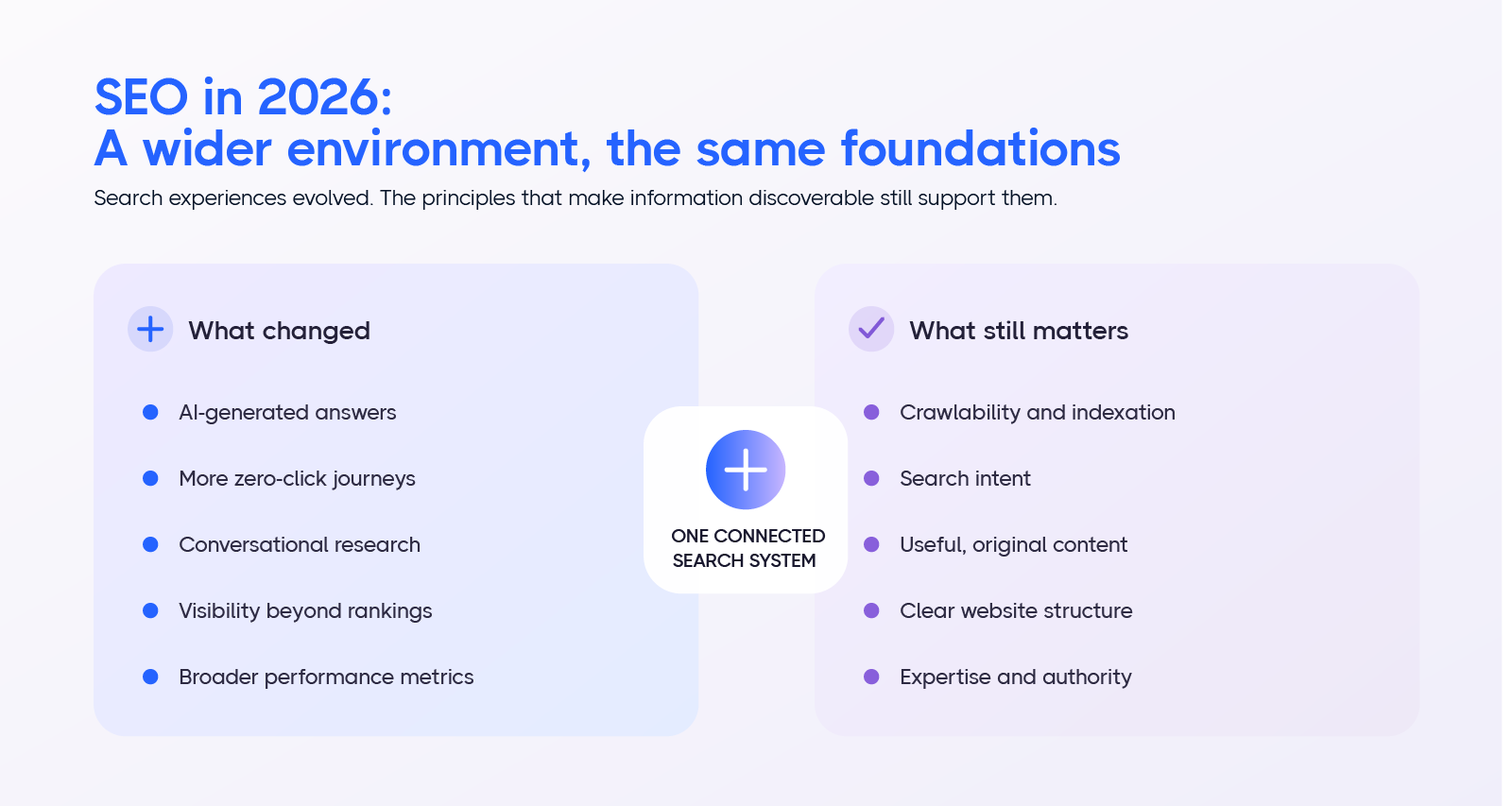
Search engine optimization is the work of making a company’s information accessible, relevant and credible when people use search systems to find answers, evaluate options or make decisions.
Historically, SEO focused mainly on earning visibility in a ranked list of Google results. That’s still important, but modern search includes a wider range of experiences:
- Traditional organic results
- AI Overviews and AI Mode
- Featured snippets
- Images and videos
- Local and product results
- Conversational and follow-up searches
- AI-generated answers supported by web sources
SEO therefore covers more than ranking a page for a keyword. It also determines whether search systems can access a company’s information, understand its relevance and consider it useful enough to present or cite.
Google makes this connection explicit. Its generative search features use the company’s core Search ranking and quality systems to retrieve current information from indexed web pages. From Google’s perspective, optimizing for generative search remains part of SEO. Pages still need to be indexed and eligible for Search before they can appear in these experiences.
The presentation of search results has changed. The need to make information discoverable and useful has not.
Search Expanded; It Did Not Simply Move From Google to AI
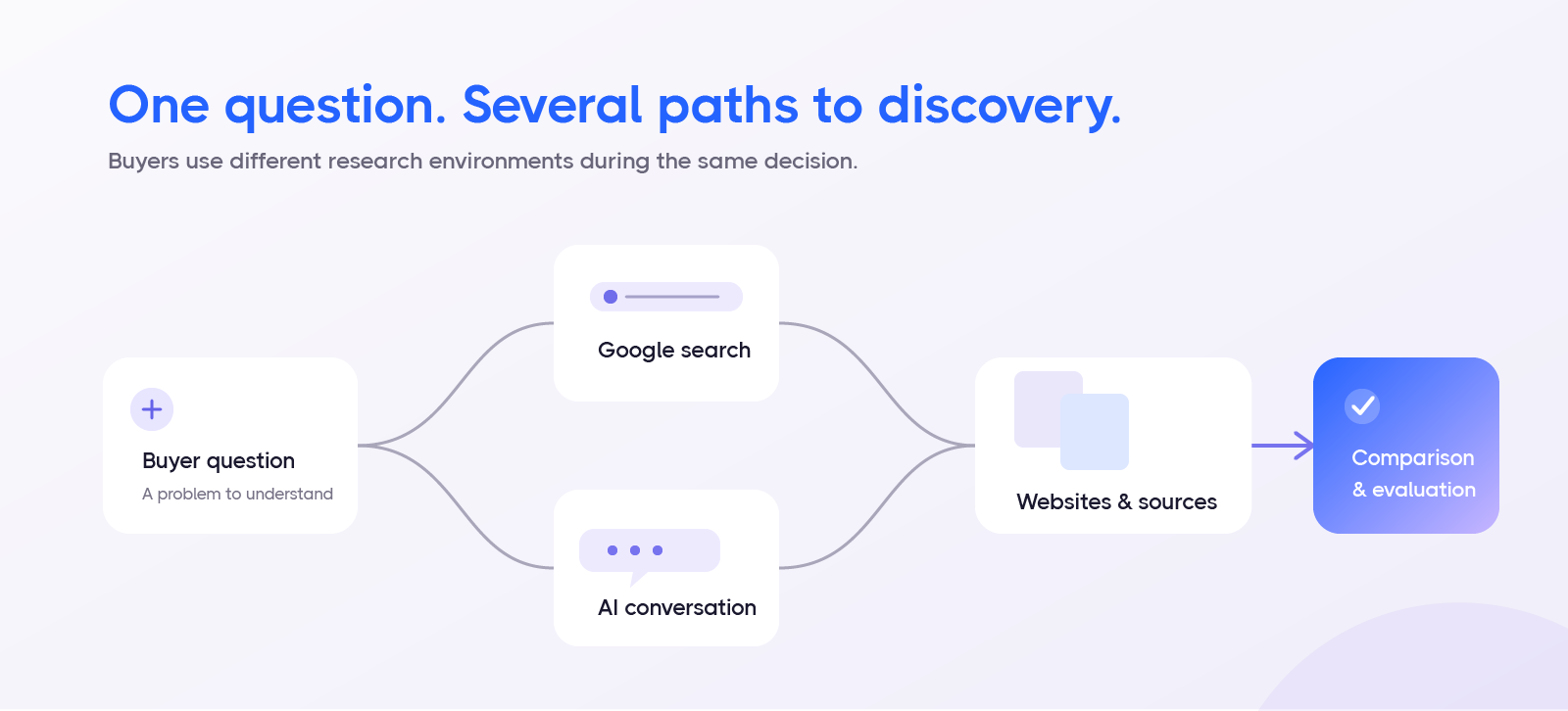
Generative AI platforms are growing quickly. Similarweb reported that worldwide visits to generative AI platforms reached 9.5 billion per month in May 2026, an increase of 70% year over year.
If you’re not familiar with how Search and AI actually work, that growth could suggest that users are replacing search engines with AI platforms. The full search journey tells a different story.
According to Similarweb, 95% of ChatGPT users also used Google in September 2025. That figure remained at 95% in May 2026, despite substantial growth in AI platform usage during the intervening period.
People are adding AI to their research habits while continuing to use conventional search.
A buyer might begin with a broad question in ChatGPT, search Google for a specific category, visit a review platform, watch a product demonstration and then search the names of shortlisted vendors. The platforms differ, but they contribute to the same research journey and buying decision.
This makes search behaviour more fragmented. It also makes visibility broader than a collection of Google rankings.
Companies now need to understand where their buyers look for information, which sources shape the answers they receive and whether the company appears consistently throughout that research.
What Actually Changed in SEO
Search results increasingly synthesize information
Traditional organic results direct users to pages that may answer their questions. Generative search can produce an answer before the user visits any source.
Google explains that its AI search features use retrieval-augmented generation to find relevant and current pages through its Search systems. The model can then use information from those pages to construct a response with supporting links.
Google also uses a process called query fan-out. A single complex question can generate several related searches behind the scenes, allowing the system to retrieve information covering different aspects of the original request.
This changes the path between a query and a source. A page may contribute to an answer even when it does not exactly match the wording of the original search. Clear topic coverage, useful detail and contextual relevance become increasingly important.
A high ranking no longer guarantees the same number of clicks
A page can keep its position in Google while receiving fewer clicks because an AI Overview answers the question before users reach the traditional results.
Ahrefs research shows the potential scale of this change. Its December 2025 analysis associated AI Overviews with a 58% lower click-through rate for the first organic result. Under comparable conditions, a page that previously received 100 clicks might receive around 42, even if it remained in first position.
Rankings can therefore no longer be treated as a reliable indicator of traffic. Companies also need to monitor click-through rates, visibility within AI-generated answers and the quality of the traffic that reaches their website.
AI-generated results are moving beyond basic informational searches
AI search initially appeared most frequently on informational questions. That is changing.
Semrush analysed more than 600,000 US desktop keywords across ten industries between November 2025 and April 2026. During this period, the presence of AI Overviews on commercial-intent search results increased by an average of 71%.
Commercial-intent searches include users comparing products, researching providers and evaluating possible purchases. The study also found considerable differences between industries, with finance and computers and electronics experiencing particularly strong growth.
This matters because AI-generated answers are moving closer to the parts of search where buying decisions take shape.
A company excluded from an informational summary may lose a visit. A company excluded from a comparison or evaluation answer may miss an opportunity to enter the buyer’s consideration set.
Search visibility is becoming more dynamic
AI search features are developing quickly, and their presence can vary across queries, industries, markets and locations.
A search that displays an AI-generated answer today may present a different format or set of sources later. This makes broad industry figures less useful for evaluating an individual company’s position.
Businesses should monitor the categories, questions and commercial searches that matter to their buyers. The goal is to understand where AI-generated results influence their specific search market, whether the company is included and which competing sources are gaining visibility.
SEO performance now requires a wider measurement model
Rankings and organic sessions are still useful. They show whether pages are being discovered and whether search is generating website visits. They do not show the complete picture.
A modern measurement model can also examine:
- Visibility across commercially relevant queries
- Presence and citations in AI-generated results
- Changes in click-through rate
- Branded search demand
- Traffic quality by topic and landing page
- Movement from educational content to commercial pages
- Content-assisted opportunities
- Organic-influenced pipeline
The appropriate metrics depend on the company and its sales process. The main change is that visibility, traffic and commercial impact must be evaluated separately before they are connected.
What Did Not Change
Search systems still need access to the content
A page cannot rank or support a retrieved answer if the relevant system cannot access and process it.
Google confirms that pages must be indexed and eligible to display a search snippet before they can appear in its generative search features. Existing technical practices therefore remain relevant, including:
- Crawlable pages
- Clear internal links
- Correct indexing directives
- Logical website structure
- Proper handling of JavaScript
- Reduced duplication
- Good performance across devices
AI has added new discovery experiences, but it has not removed the need for a technically reliable website.
Search intent still determines relevance
A page succeeds when it satisfies a real information need.
Keyword wording may become more conversational, and a model may generate several related queries behind the scenes. The underlying requirement remains the same: the content needs to address what the person is trying to understand or accomplish.
For businesses, this means looking beyond keyword volume to identify:
- Who is searching
- Why the search is happening
- What the person already understands
- Which decision the information could influence
- What the reader will need next
- Whether the company has credible expertise to contribute
AI can interpret more complex queries, but it does not make irrelevant content useful.
Original expertise still carries more value than generic volume
Generative AI has made it easier to produce large quantities of competent-looking content. It has also reduced the value of publishing information that simply restates what already exists.
Google advises website owners to create original, useful and “non-commodity” content for generative search. Its guidance specifically distinguishes first-hand experience and unique perspectives from summaries that reproduce information already available elsewhere. It also warns against creating large numbers of pages primarily to influence rankings or AI-generated responses.
Useful originality can take several forms:
- First-hand experience
- Original research or data
- A clear expert interpretation
- Detailed use cases
- Proprietary frameworks
- Practical implementation guidance
- Evidence that competitors cannot easily reproduce
The objective is not novelty for its own sake. The content should add something that helps a person, or a search system, understand the subject more accurately.
Technical SEO still provides the foundation
Technical SEO may receive less attention than AI visibility, but the relationship is straightforward: if important content cannot be reliably discovered, rendered and indexed, it cannot perform consistently in traditional or generative search.
Core areas still include:
- Crawlability
- Indexation
- Canonicalization
- Website architecture
- Internal linking
- Page performance
- Mobile usability
- Structured data where appropriate
- Redirect and migration management
No AI-specific tactic can compensate for a website that prevents search systems from reaching its most valuable information.
Authority still affects which sources deserve visibility
Search and AI systems have access to many pages making similar claims. They need ways to assess which information is useful, credible and supported.
Authority develops through a combination of:
- Demonstrated subject expertise
- Consistent coverage of relevant topics
- Named and credible authors
- Original evidence
- Relevant backlinks
- Reviews and third-party validation
- Mentions in trusted industry sources
- Consistent information about the company across the web
Authority cannot be reduced to a single domain score. It reflects the wider evidence that a company understands a subject and has a legitimate place within the category.
What Became Less Useful
Several familiar SEO activities still produce attractive reports while contributing little to meaningful visibility.
Selecting topics through volume alone
High search volume can generate traffic without reaching the intended buyer. Commercial relevance, audience fit and connection to the company’s expertise deserve equal consideration.
Publishing interchangeable articles
Generic summaries compete with thousands of similar pages and give search systems little reason to select one source over another.
Reporting rankings without context
A ranking position does not show whether an AI feature appears above it, whether click-through rates changed or whether the traffic produces qualified engagement.
Assuming every search should lead to a visit
Some questions are now resolved directly within search results or AI interfaces. Companies also need to understand the value of accurate mentions, citations and repeated brand exposure.
Treating Google as the entire research journey
Buyers can move between search engines, AI platforms, review sites, industry publications, video, social platforms and branded searches. These environments influence one another.
Chasing unsupported GEO tactics
AI visibility has created a market for shortcuts, including unnecessary files, mechanical content formatting and artificial mentions. Google explicitly advises businesses to prioritize foundational SEO and valuable content over unverified AEO or GEO techniques.
Separating SEO, AI visibility and authority into unrelated programs
The same content, technical foundation and external evidence often influence several discovery environments. Separate measurement may be necessary, but the underlying strategy should remain connected.
Is SEO Still Important in 2026?
Yes.
SEO remains important because traditional and AI-assisted search depend on accessible, relevant and credible information. Google’s generative features still rely on its Search index and ranking systems. Users continue to use Google while adding AI platforms to their research habits. AI-generated results are also expanding into commercially important searches.
What changed is the scope of the work and how success should be evaluated.
A company can no longer assume that ranking automatically produces the same traffic or that traffic automatically creates business value. SEO now needs to support discovery, accurate representation and buyer confidence across a wider research environment.
What Companies Should Prioritize Now
Companies do not need to abandon their SEO foundations and start again. They need to adapt those foundations to the current search landscape.
The priorities are clear:
- Protect technical accessibility. Ensure important content can be crawled, rendered and indexed reliably.
- Map commercially relevant demand. Understand the questions buyers ask across problem recognition, solution research and vendor evaluation.
- Strengthen commercial pages. Product, service, category and use-case pages should provide enough clarity and evidence to support evaluation.
- Publish original expertise. Prioritize experience, research, useful frameworks and detailed insight over generic publishing volume.
- Monitor AI-generated results. Track whether the company appears, how it is described and which sources support the answer.
- Build authority beyond the website. Develop credible reviews, relevant mentions, expert commentary, partnerships and industry references.
- Connect visibility with business outcomes. Measure qualified engagement, content-assisted opportunities and organic-influenced pipeline alongside rankings and sessions.
SEO Has a Wider Job Now
The fundamentals of SEO remain intact. The environment in which they operate has expanded.
Search now includes ranked pages, synthesized answers, follow-up conversations and research across multiple platforms. Some visibility will generate a website visit. Some will shape recognition and consideration before the buyer ever reaches the site.
Companies that focus only on traditional rankings will miss part of that environment. Companies that abandon SEO in pursuit of AI visibility will weaken the technical, content and authority foundations that both depend on.
The practical path is to treat search and AI visibility as connected parts of the same buyer journey: make important information accessible, answer commercially relevant questions, demonstrate genuine expertise and build enough external authority to be found and trusted wherever research happens.
For a practical framework, download the B2B SEO Strategy Executive Playbook and learn how to map search visibility across the buyer journey, build authority clusters and create a 90-day visibility roadmap.