

A cybersecurity provider can be active on LinkedIn, appear in the press, and have experienced people speaking at events. But when a potential customer visits its website, they may find little explanation of how its services actually work.
We audited five cybersecurity providers in the UAE and here’s what we found:
One company gave buyers a more complete picture of its expertise. Another was easier to find on Google. A third appeared more often in AI recommendations. Each had strengths, but each also left buyers with unanswered questions. Getting attention, being found, and earning trust did not always happen together.
These differences matter when deciding where to spend your marketing budget. More posts or articles may not fix a website that is hard to find, a service that is hard to understand, or claims that buyers cannot verify. This audit shows where those gaps appeared and what cybersecurity companies can do about them.
Five Cybersecurity providers in the UAE compared
We selected five UAE providers whose websites showed overlapping services: outsourced security monitoring, security assessments, penetration testing, incident response, and consulting. Their service pages suggested they were competing for many of the same searches and buyer questions.
We reviewed how clearly each company explained its services, how useful its website content was, and whether its website supported search discovery. We also looked at Google rankings, appearances in AI answers, LinkedIn activity, media coverage, expert contributions, customer reviews and case studies, and ways for visitors to take the next step.
What separated the three leaders
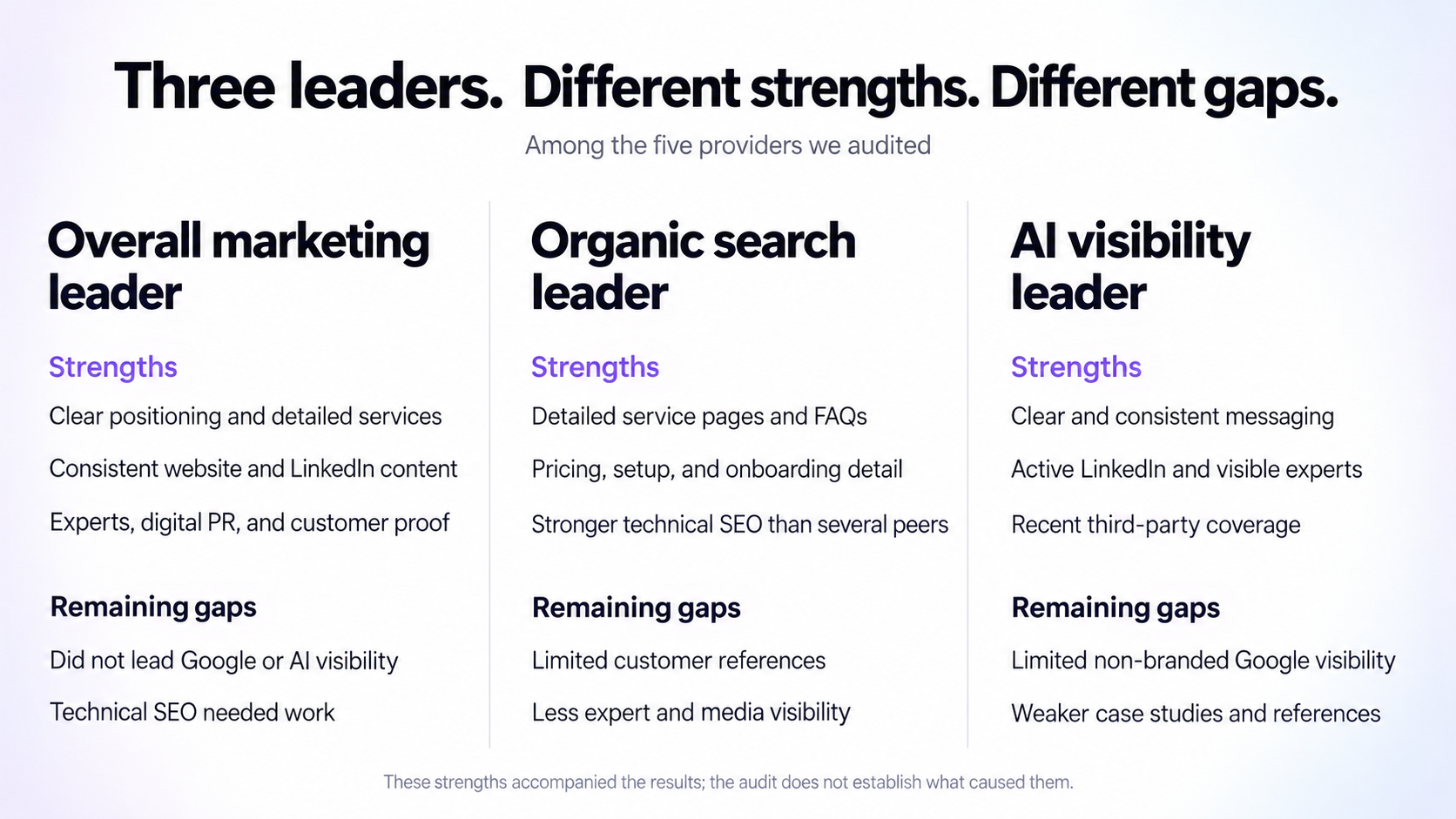
The overall leader built a fuller picture of the company.
It explained what it did more clearly, provided more detailed service pages, and published educational content consistently. Sustained LinkedIn activity, expert contributions, digital PR, and stronger customer evidence supported that work. Buyers had more information to judge whether the company was a good fit and could deliver.
Its remaining challenge was discovery. It did not lead our Google tracking for searches that did not include a company name, or our AI tracking. A strong public presence still left room to improve how new buyers found it.
The search leader made its services easier to research.
Dedicated service pages included practical information such as FAQs, pricing, how services were set up, and how customers got started. Its website organized these topics clearly and had a stronger technical SEO foundation than several peers. These strengths stood out alongside its broader Google visibility, though the audit does not prove what caused its rankings.
Customer references, expert contributions, and media coverage were less developed. Visitors could learn more about the service than about the company’s record of delivering it.
The AI leader was more frequently included in recommendations.
It explained its services clearly and consistently, stayed active on LinkedIn, featured its experts, and had recent coverage from outside sources. These strengths were present alongside its AI appearances; they do not prove why AI systems selected it. Its Google visibility remained limited for searches without a company name, and its customer case studies and references were weaker.
Leading in one area can leave an important gap elsewhere.
Eight gaps cybersecurity companies should pay attention to
1 – Buyers could see the services but not always whether the provider suited them
All five explained their main services. But it was not always clear who those services were designed for, which industries the company understood, or why a buyer should choose it.
Words such as “flexible,” “experienced,” and “cost-effective” leave a lot for the reader to figure out. A company outsourcing security monitoring needs more specific answers: Can the provider work with its existing tools? Will it support the internal team or take full responsibility for monitoring and response?
These details help buyers recognize a good fit. They also give the company clearer reasons to be chosen than broad claims its competitors could make.
Our recommendation: Explain who you serve, their industries and which problems you help them solve. Describe how you work, the tools and environments you support, and the commitments you can back up. Keep that message consistent across your website and company profiles, with the right level of detail for each channel.
2- Service pages often stopped before the questions that influence a decision
Some service pages listed what the company could do without explaining what a customer would receive. Details about delivery, reporting, responsibilities, and getting started were limited.
A buyer may already know why they need a security assessment. What they need next is practical detail: what will be tested, what the report includes, whether the provider will help fix the issues it finds, and what happens afterward.
The search leader stood out for practical detail. Its dedicated service pages answered more of these buying questions. Visitors could understand the service more easily, and search engines had more specific information to match to relevant searches.
Our recommendation: Treat your main service pages as part of the sales conversation. Ask your team what prospects want to know before agreeing to a meeting or proposal, and answer those questions on the page. Explain what is included, how the work happens, what the customer receives, what they need to provide, and how to get started. Give buyers enough detail to compare their options without overwhelming them.
3- Technical SEO needed attention even where marketing strategy was strong
The audit flagged possible restrictions on automated website access on three of the five websites. We also found broken links, pages returning errors, and gaps in how important pages were organized and described.
Technical SEO is the work that helps search engines access and understand a website. Search engines use automated programs, called crawlers, to visit pages. They then decide which pages to include in their search index, the collection of pages that can appear in results. If an important page cannot be reached or included, improving its writing will not fix the access problem.
AI search also needs access to information. For a page to appear as a supporting link in Google’s AI search features, it must be indexed and eligible to appear with a snippet in regular search. Other AI services have their own access requirements. A restriction affecting one crawler does not mean every search engine or AI service is blocked. However, we noticed that the companies that did not show up in AI answers are blocking AI bots access.
Google’s technical guidance identifies accessible, working pages with content that can be indexed as basic requirements. Its AI search guidance applies the same foundations to AI Overviews and AI Mode.
Our recommendation: Before investing in more search content, ask your website or SEO team to check whether search engines can access and index your important pages. Confirm that links work, service pages load correctly, and security settings allow the search and AI services you want to reach. Ask the team to explain which problems matter most, why they matter, and what to fix first. Repeat these checks as pages, website tools, and security settings change.
4- Educational content did not always build a clear connection to the business
Some providers published useful technical research, but the depth and frequency of their content varied. In some cases, the content showed expertise without explaining how it connected to the company’s services.
An article can help readers understand a security problem, compare ways to address it, and learn how the provider approaches the work. Without that connection, readers may leave better informed but still unsure how the company can help.
Original research and data can make this content more useful. Findings from assessments, patterns shared without identifying customers, technical experiments, and delivery-team experience give readers something they cannot get from a generic summary. Practical guides, real examples, webinars, and checklists can help buyers understand and act on the same issue.
Google’s content guidance supports this approach. It emphasizes original information, thorough explanations, and clear evidence of expertise.
Our recommendation: Plan content around the problems and decisions your customers face. Involve the people who deliver your services so the advice includes real experience. When sharing original data, explain how you collected it and protect sensitive information. Link each resource to a relevant service or useful next step. Choose the format that helps readers most, whether that is an article, a checklist, or a webinar. Publish regularly, but make sure each piece has something useful to say.
5- Social activity does not automatically translate into search visibility
One provider was active on LinkedIn, featured its leaders, and had recent media coverage. Yet we recorded no Google rankings or AI brand mentions for it in our selected sample. Its website also lacked service detail and had technical issues.
Social media and search reach buyers in different ways. A company can be familiar to its network but difficult to find when someone outside that network searches for a service.
Announcements often have a shorter life than useful website content. An event post may attract attention for a few days. Ideas discussed at that event can become an article, guide, or expert interview that helps buyers long after the event ends.
Our recommendation: Give LinkedIn, media outreach, and website content shared priorities. Turn useful interviews, research, and event discussions into resources that stay relevant, then share them where your buyers spend time. When announcing a partnership, explain what it enables you to do for customers. Help people understand your expertise wherever they encounter your company.
6- Customer evidence was weaker than the capability claims
Four of the five providers had limited customer reviews or references available to the public. Some examples and testimonials were too brief to explain what the provider had done.
Certifications, vendor partnerships, and media coverage can help build trust. Customer evidence answers a more practical question: what has this provider done for a company like ours?
A useful case study explains the customer’s problem, what the provider did, and what changed. If the customer’s name must remain private, an approved example without identifying details can still show how the work helped.
Our recommendation: Make customer evidence part of your regular marketing work. Ask delivery teams which results can be documented, get the necessary permission, and publish examples on or near the relevant service pages. Explain what your certifications cover and keep them current. Give buyers enough evidence to judge your claims for themselves.
7- Google and AI visibility were uneven and needed a connected strategy
The company that appeared for the widest range of tracked Google searches was different from the one mentioned most often in AI answers. The overall marketing leader led neither.
Google results and AI recommendations help buyers research in different ways. In a regular search, people choose which pages to visit. An AI answer may give them a summary and a list of suggested providers based on selected sources. You need to consider both whether buyers can find your pages and whether AI answers describe your services accurately.
SEO, or search engine optimization, and AI visibility share basic requirements: accessible pages and clear, useful information. Work on both together, while recognizing that better results in one do not guarantee better results in the other.
Google retains foundational SEO practices for its AI features. Microsoft also recommends clear, complete information that its systems can reference accurately.
Our recommendation: Build one plan around the services you want to be known for, and check Google and AI results separately. Explain your company, expertise, and services clearly on your website. Create opportunities for your experts to contribute to relevant publications and industry discussions. Track the searches and questions your buyers use, then review which pages and sources appear. Use what you learn to improve your content and address missing information.
8- A contact form was often the only meaningful next step
All five made it easy to find a way to contact them. Three offered few options beyond a general inquiry. Others gave visitors more choices, such as service consultations, event registrations, and meeting requests.
Visitors arrive with different needs. One may be ready to discuss outsourcing. Another may be comparing options or gathering information for their team. A general contact form is most useful to someone already ready for a conversation.
A downloadable checklist or guide gives people who are still researching something useful to do next. It can help them solve a specific problem and create an opportunity to continue the conversation. Webinars, focused consultations, and assessments with a clear purpose can also help.
Our recommendation: Match the next step to what the visitor is trying to do. A service page could offer a consultation about an assessment. An educational article could link to a useful guide or webinar. Explain what people will get before asking for their details. Keep forms short and request only what you need at that stage. Make introductory content available without a form, and use registration where the resource offers enough value to justify it.
What companies should do with these findings
For some companies, the first step is to make existing marketing work better together. Publishing more will not solve a website access problem, explain an unclear service, or fill a gap in customer evidence.
Start with the services that matter most to your business. Follow the path a potential customer would take: search for a provider, visit the service page, look for evidence, and try to take the next step.
If your company is hard to find, check whether search engines can access your pages and whether those pages answer relevant searches. If the service is hard to compare, add practical detail. If your claims are hard to verify, publish useful customer examples and expert contributions. If the only next step is a general form, add an option for someone still researching.
Use this exercise to set priorities for your website, SEO, content, LinkedIn, and media outreach. Fix the gaps that stop buyers from moving forward before adding more activity.
Six practices worth building into your marketing
- Start with shared priorities. Agree on the customers, services, and buyer questions that matter most. Use them to guide website content, SEO, LinkedIn, and media contributions so people get a consistent picture of your business.
- Explain every important service clearly. Give each distinct service a detailed page with clear headings and links to useful resources. Avoid creating several pages with little information just to target slightly different search phrases.
- Make expertise and evidence easy to verify. Identify the people behind your content when appropriate. Explain their relevant qualifications, share customer results with permission, and keep company details accurate across public sources.
- Share what your team has learned firsthand. Use practical experience, original analysis, and data you can explain. Help readers make a decision with information they would not get from another general summary.
- Keep your website useful and current. Review important pages, test forms and links, update old information, and remove expired information. Check your website on a phone as well as a computer. Information should be easy to find and use on both.
- Measure whether your marketing helps buyers. Track relevant Google and AI appearances, how visitors use important pages, and the quality of inquiries. Review results over time. Post counts and views show activity, but they cannot tell you on their own whether buyers understand your services or trust you to deliver.
What the different leaders teach us
The overall leader gave buyers a more complete, consistent picture of the company through its website, LinkedIn, expert contributions, digital PR, and customer evidence. Its next opportunity was to help more buyers discover that work through Google and AI.
The search leader made its services easier to research through practical detail and a stronger website foundation. Its next opportunity was to give visitors clearer evidence that the company could deliver, along with more useful ways to take the next step.
The AI leader appeared more often in recommendations and explained its services consistently across its public marketing. Its next opportunity was to add stronger customer evidence and improve regular Google visibility. Reviewing the sources cited in its AI appearances could help it understand where to focus next.
Look at what happens after each marketing success. When someone finds you, can they understand the service? When they understand it, can they verify your claims? When they are interested, is there a useful next step? These connections help turn visibility into a better buying experience.
At Craxis, we review these connections to help B2B technology companies decide where to focus their marketing. If you are reviewing your priorities, contact us to get an initial assessment that can help identify the gaps to address first.
These findings cover five providers and the searches and AI questions included in our review. They describe publicly available marketing, not the quality of the providers’ services or their business results.